Madonna University, Nigeria

Library and Information Science Department

KNOWLEDGE
Faculty of Management Sciences • LIS Department
Faculty of Management Sciences

Library & Information Science

Pioneering the intersection of information management and emerging technologies to develop ICT-compliant professionals for the digital information age.
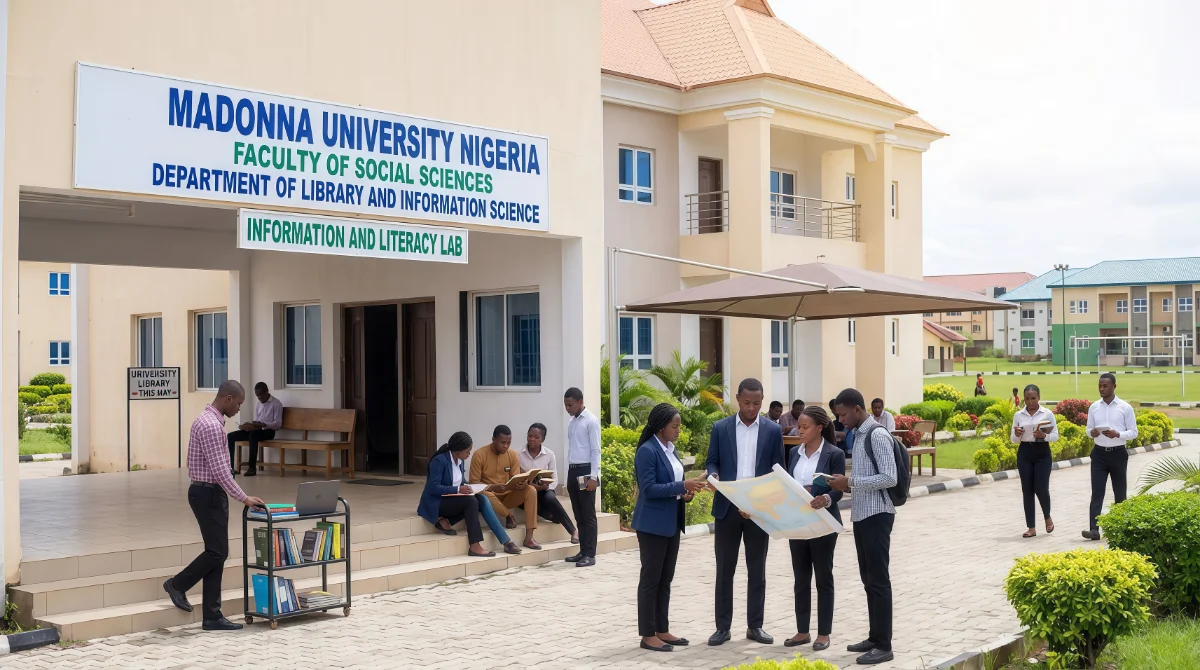
Madonna University, Nigeria
Okija Campus • Management Sciences
LIS Department
B.LIS
Degree Programme
Okija
Campus
NUC
Approved
LIS Background
Departmental Heritage

Pioneering Information Science

Established in October 1999, the Department of Library and Information Science at Madonna University was one of the first library schools in a private university in Nigeria. The discipline is centered on the sophisticated ways in which information is created, collected, organized, analyzed, and disseminated.

In response to the rapid growth of communication technologies and the evolving labor market, the department provides professional training designed to produce ICT-compliant information managers. Our philosophy is rooted in national objectives: fostering a just, democratic society and a self-reliant, dynamic economy through the strategic management of knowledge.

Programme Objectives

Strategic Goals

Equip students with theoretical knowledge and practical skills to enhance job performance across all types of documentation centres.

Encourage a spirit of enquiry and creativity to understand information's role in complex, multi-cultural, and non-literate societies.

Provide a robust professional background allowing graduates to adapt seamlessly to any changing information environment.

Develop advanced understanding of new communications technologies and the internet in handling global information.

Produce competent information managers capable of operating in educational, corporate, and governmental institutions.

Foster the intellectual capability to solve complex information retrieval and organization problems.

Entry Standards

Admission Requirements

UTME Admission

Candidates must obtain an acceptable UTME score and possess at least five credits in WASC/NECO (or equivalent), including English Language and Mathematics, in no more than two sittings.

Direct Entry Path

Eligible candidates include holders of the Nigeria Certificate in Education (NCE), a Diploma in LIS (Credit level), or those with five GCE 'O' Level credits plus two Advanced Level passes.

Academic Eligibility

Program Qualifications

Minimum Standard

All Direct Entry candidates must possess at least four credits, including English Language in GCE ordinary level, to ensure professional linguistic competence.

Professional Framework

Program Architecture

The B.LIS degree consists of integrated professional courses and academic disciplines. To ensure effective documentation and retrieval, the department mandates a language requirement in either French or German, which must be met before graduation.

Field Experience

A mandatory six-month supervised field program in an approved information institution to relate theoretical knowledge to professional practice.

Capstone Research

Completion of a supervised professional essay (5,000 to 10,000 words) demonstrating the student's ability to solve a professional problem through documented research.

Professional Framework

Program Architecture

The B.LIS degree consists of integrated professional courses and academic disciplines. To ensure effective documentation and retrieval, the department mandates a language requirement in either French or German, which must be met before graduation.

Field Experience

A mandatory six-month supervised field program in an approved information institution to relate theoretical knowledge to professional practice.

Capstone Research

Completion of a supervised professional essay (5,000 to 10,000 words) demonstrating the student's ability to solve a professional problem through documented research.

Academic Specialization

Core Stress Areas

Introduction & Foundation Courses (Area 0)
Organization of Knowledge (Area 1)
History of Libraries (Area 2)
Computer Applications in Libraries (Area 3)
Library Administration (Area 4)
Information Sources & Services (Area 5)
Information Marketing (Area 6)
Publishing & Book Trade in Library Science (Area 7)
Research Methods in Library Science (Area 8)
Professional Research Project (Area 9)
ACCESS
Future Outlook

Elite Career Pathways

Chief Information Officer

Overseeing the strategic implementation of information technology and data management for large organizations.

University Librarian

Managing academic resource centers to support high-level research, pedagogy, and scholarly discourse.

Knowledge Manager

Designing systems to capture and disseminate intellectual capital within corporate and government sectors.

Digital Archivist

Preserving critical historical and corporate data using advanced electronic preservation techniques.

UN/UNESCO Consultant

Collaborating with international bodies to improve global access to information and literacy.

Information Consultant

Providing specialized advisory services on data organization and retrieval for private firms.

Corporate Librarian

Managing critical intelligence and proprietary data for banks, oil companies, and law firms.

Data Curator

Organizing complex datasets to ensure accessibility and usability for research and analytics.

Records Manager

Ensuring regulatory compliance and operational efficiency through professional records auditing.

Information Specialist

Operating at the intersection of IT and Library Science to facilitate rapid information retrieval.

Master the Information Age

Become a leader in the global knowledge economy. Turn information into impact with the Department of Library and Information Science.

B.LISInformation Science Degree
"Empowering society through the strategic organization and dissemination of knowledge."
Scroll to Top