Electrical /
Electronics Engineering
Powering modern life through the mastery of energy delivery, intelligent electronic devices, and sophisticated control systems.
Electrical & Electronics
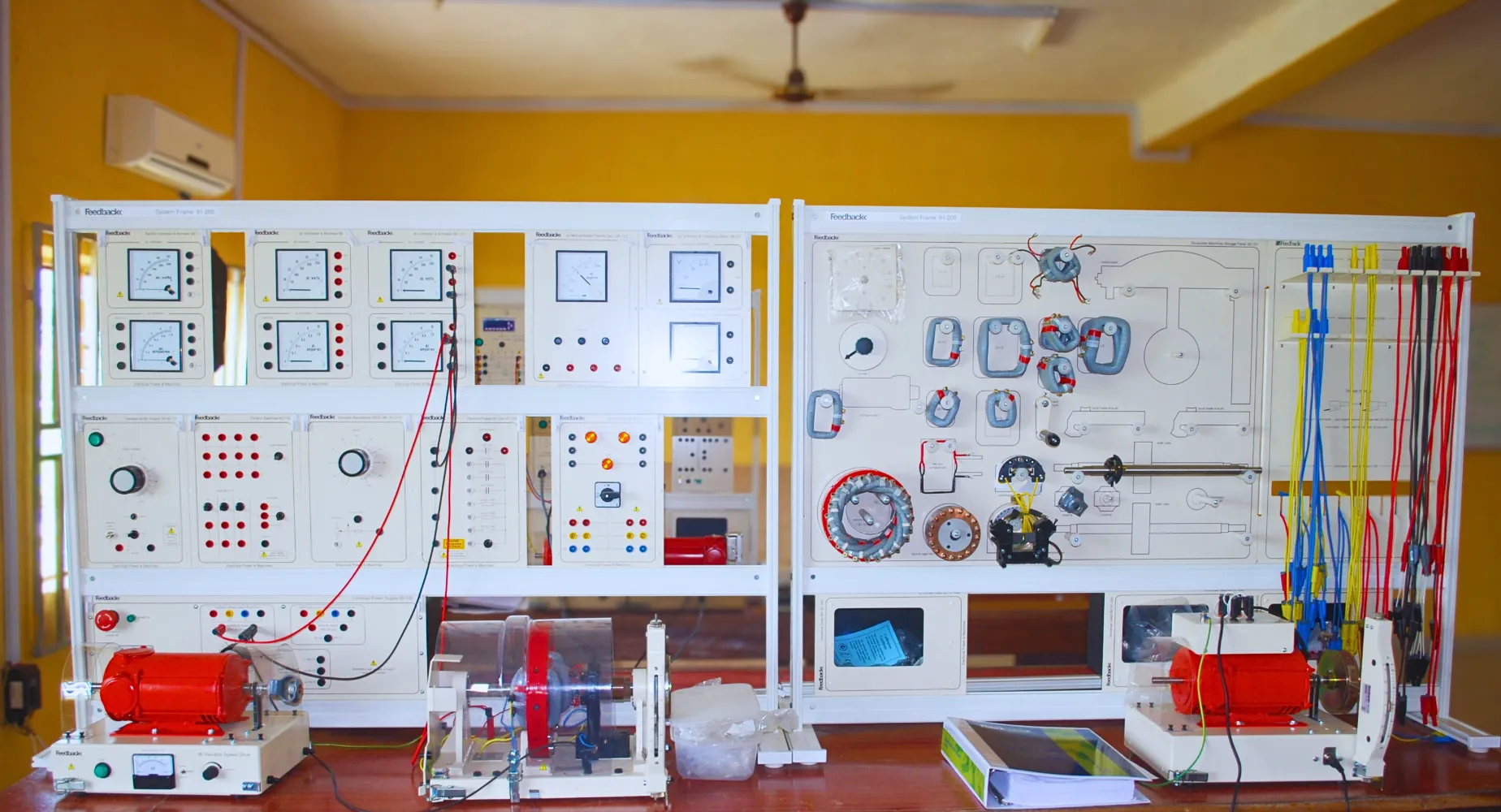
Electrical and Electronics Engineering trains students to operate across the diverse realms of power systems, electronic circuitry, instrumentation, and related industrial technologies.
The department is dedicated to preparing engineers who can design, operate, and maintain electrical technologies in strict accordance with global professional standards and industrial safety.
Our Philosophy
The department views electrical and electronic engineering as the fundamental discipline that powers modern life—from massive energy delivery networks to the intelligent devices and communication systems that define the digital era.
Practice and Service
Students are guided to integrate high-level analytical thinking with practical technical competence, always grounded in ethical responsibility and public safety.
Professional Readiness
We combine rigorous theoretical study with disciplined hands-on laboratory work, ensuring our graduates can lead in industrial automation and energy management.
Strategic Objectives
Train a specialized cohort of engineers equipped to address the complex challenges of the modern electrical and electronic industries.
Impart the core engineering principles required to plan, design, operate, and manage critical industrial power and control systems.
Provide deep technical knowledge for diverse industrial practices, ranging from large-scale power plants to small-scale electronics manufacturing.
Ensure all graduates are professionally prepared for registration with key regulatory bodies, specifically COREN.
Programme Standards
Primary Disciplines
- Power systems and machines
- Electronics and automation
- Instrumentation and control
- Communication systems
Entry Requirements
- UTME or Direct Entry tracks
- Credits in Math, Physics, and Chemistry
- Aptitude for complex system design
Professional Aim
- Design of electronic devices
- Power network optimization
- Biomedical system implementation
- COREN licensure
The Four Stress Areas
The Electrical/Electronic Engineering programme is built on four foundational pillars of specialization, ensuring that graduates can adapt to any technological sector, from heavy energy infrastructure to micro-scale biomedical instrumentation.
- Power System (EEP): Generation, transmission, and grid stability.
- Electronics & Comm (EEE): Circuit design and signal processing.
- Instrumentation & Control (EEI): Precision measurement and automation.
- Biomedical Engineering (EEB): Medical device and health-tech systems.
Admission Requirements
Entry Pathways
Admission to the 5-year Electrical and Electronics Engineering programme is conducted through a rigorous evaluation of academic merit:
- UTME Track: Candidates must possess five passes in SSCE/GCE, including English, Mathematics, Physics, and Chemistry.
- Direct Entry: Candidates must hold GCE 'A' level or equivalent in Math, Physics, and Chemistry.
- Added Advantage: Proficiency in Further Mathematics and Technical Drawing is highly desirable.
Academic Progression
The programme is structured to move students from theoretical physics and mathematics toward advanced system design and implementation:
- OND holders may be admitted into 200 level.
- HND holders (Upper Credit) may be admitted into 300 level.
- Rigorous curriculum in power, control, and instrumentation.
Faculty Transfers
Inter-departmental transfers are permitted after one full academic year, subject to the following institutional standards:
- A minimum CGPA of 1.00.
- Formal application to the University Registrar.
- Approval by Faculty and Departmental Boards.
- Final endorsement by the University Senate.
Professional Career Pathways
Energy & Power Utilities
Managing the generation, transmission, and distribution of electrical power for national grids and industrial complexes.
Automation & Robotics
Designing intelligent control systems and autonomous machinery to enhance industrial productivity and precision.
Telecommunications
Developing the next generation of communication hardware, fiber optics, and wireless data transmission networks.
Instrumentation & Control
Implementing high-precision monitoring and control systems for critical infrastructure and industrial processes.
Biomedical Engineering
Creating life-saving medical instrumentation and electronic diagnostic tools for healthcare systems.
Aerospace & Defense
Designing robust electronic systems for aviation, satellite communications, and national security infrastructure.
Study Electrical Engineering with Purpose
Join a department dedicated to the mastery of power and precision. From the smallest microchip to the largest power grid, we provide the technical depth and professional discipline required to lead the energy transition.